Research
Research Overview
My research investigates the neural mechanisms underlying mathematical thinking, with particular emphasis on numerical cognition and fraction processing. I use advanced electrophysiological methods (EEG/ERP) combined with behavioral experiments to understand how the brain processes mathematical information.
Publications
- Salehzadeh, R., Rivera, B., Man, K., Jalili, N., & Soylu, F. (2023). EEG decoding of finger numeral configurations with machine learning. Journal of Numerical Cognition, 9(1), 206–221. https://doi.org/10.5964/jnc.10441
- Rivera, B., & Soylu, F. (2021). Incongruity in fraction verification elicits N270 and P300 ERP effects. Neuropsychologia, 161, 108015. https://doi.org/10.1016/j.neuropsychologia.2021.108015
Under review
- Rico-Pico, J., Rivera, B., Fox, N. A., Noble, K. G., & Troller-Renfree, S. V. (under review). Associations between functional brain activity and cognitive skill among children residing in poverty.
In preparation
* undergraduate co-author
- Rivera, B., & Salehzadeh, R. (in preparation). Componential and holistic representations of fractions emerge together: Multivariate EEG evidence for a hybrid model.
- Rivera, B., Hendrickson, M.*, & Sticka-Jacobs, A.* (in preparation). Number format effects in arithmetic processing: Behavioral and ERP comparison of symbolic and non-symbolic answer verification.
Recent Presentations
- Rivera, B. (2026). An open-data undergraduate EEG/ERP methods course at a primarily undergraduate institution: Design and first offering. Late-breaking abstract submitted to Neuroscience 2026, Society for Neuroscience, Washington, DC, November 14–18.
- Hendrickson, M.*, Sticka-Jacobs, A.*, & Rivera, B. (2026, April). EEG responses to incorrect arithmetic answers: Evidence of format-dependent arithmetic processing. Poster presented at the Minnesota Undergraduate Psychology Conference.
- Rivera, B. (2026, March). Parts and wholes: Decoding fraction processing insights from EEG brain signals. Mathematics, Statistics, and Computer Science Department Colloquium, St. Olaf College.
Funding
- NIH R21, National Institute of Child Health and Human Development (submitted October 2025, under review). Co-investigator; principal investigator Angela AuBuchon, Boys Town National Research Hospital. Attention control and EEG.
- Professional Development Grant, Faculty Life Committee, St. Olaf College (2026, $2,100). Developing and evaluating an undergraduate EEG/ERP methods course as a replicable model for liberal arts institutions.
- Collaborative Undergraduate Research and Inquiry (CURI), St. Olaf College (Spring, Summer, and Fall 2026). Paid research positions for Root Lab students.
Lab and Equipment
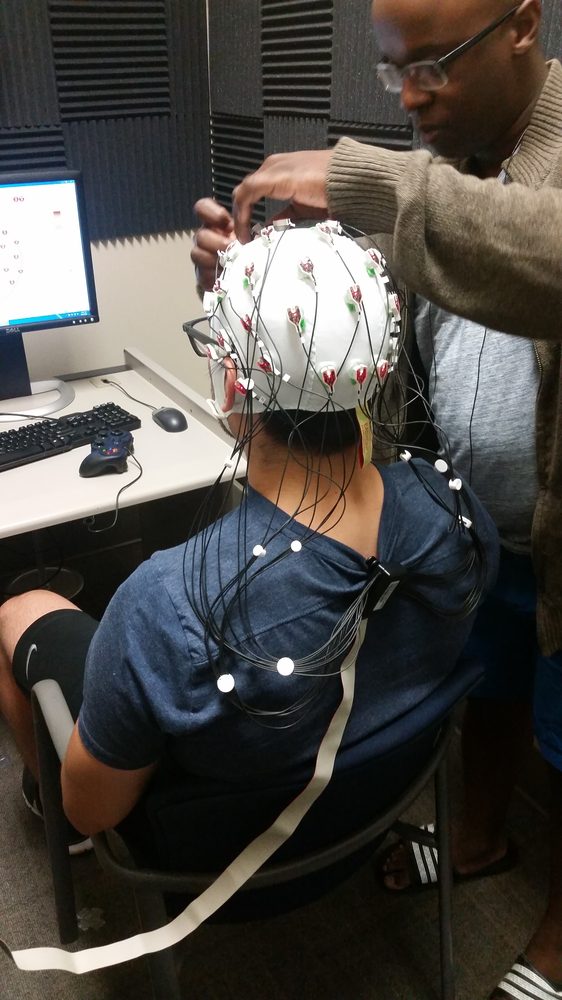
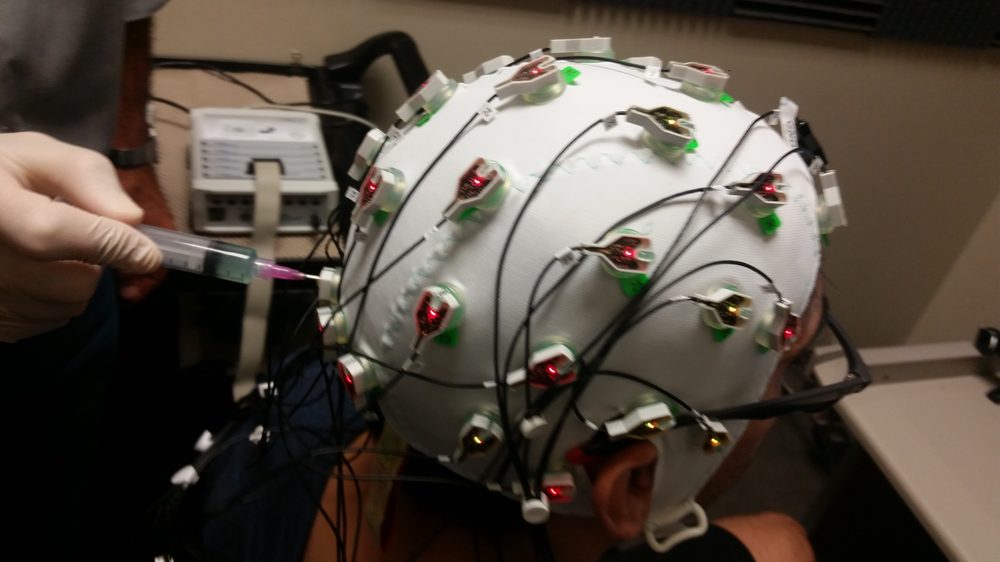
The Root Lab records EEG with a 16-channel BIOPAC system and Electro-Cap electrode caps. I built the setup in 2025–26 from existing departmental equipment, and it has been used for the arithmetic verification (FAVE) and equation-graph (GRASP) EEG studies.
Collaborators
Firat Soylu (University of Alabama) · Roya Salehzadeh (Texas State University) · Angela AuBuchon (Boys Town National Research Hospital)
Current Projects
Multivariate EEG Decoding of Fraction Processing
Understanding how people access fraction magnitude is crucial for mathematics education, as fractions represent a fundamental gateway to higher-level mathematical concepts. This project applies cross-generalization decoding techniques to test whether neural representations of fraction magnitude are abstract or tied to specific surface forms. We examine whether brain patterns learned from one fraction notation (e.g., 2/4) can successfully predict equivalent fractions in different forms (e.g., 3/6, 4/8).
Fraction Scaling (Processing Costs of Fraction Comparisons Across Scales)
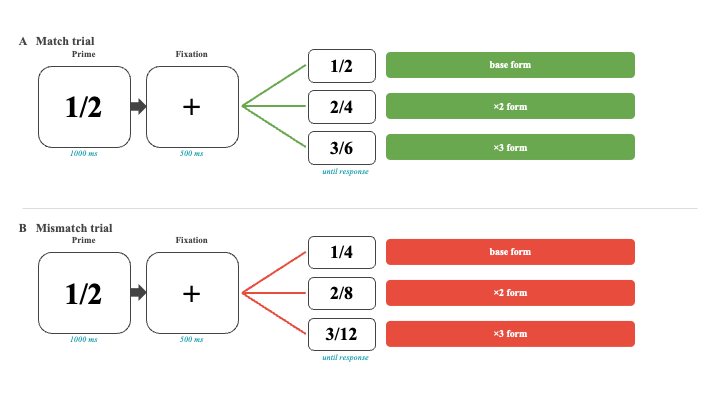
This behavioral study asks whether comparing fractions of the same magnitude but different scale—such as 1/2 versus 2/8—carries a processing cost, and whether that cost follows a numerical distance effect. Adults complete a fraction verification task with fractions shown in base form or scaled by ×2 or ×3.
GRASP Experiment (Graph Reasoning and Symbolic Processing)
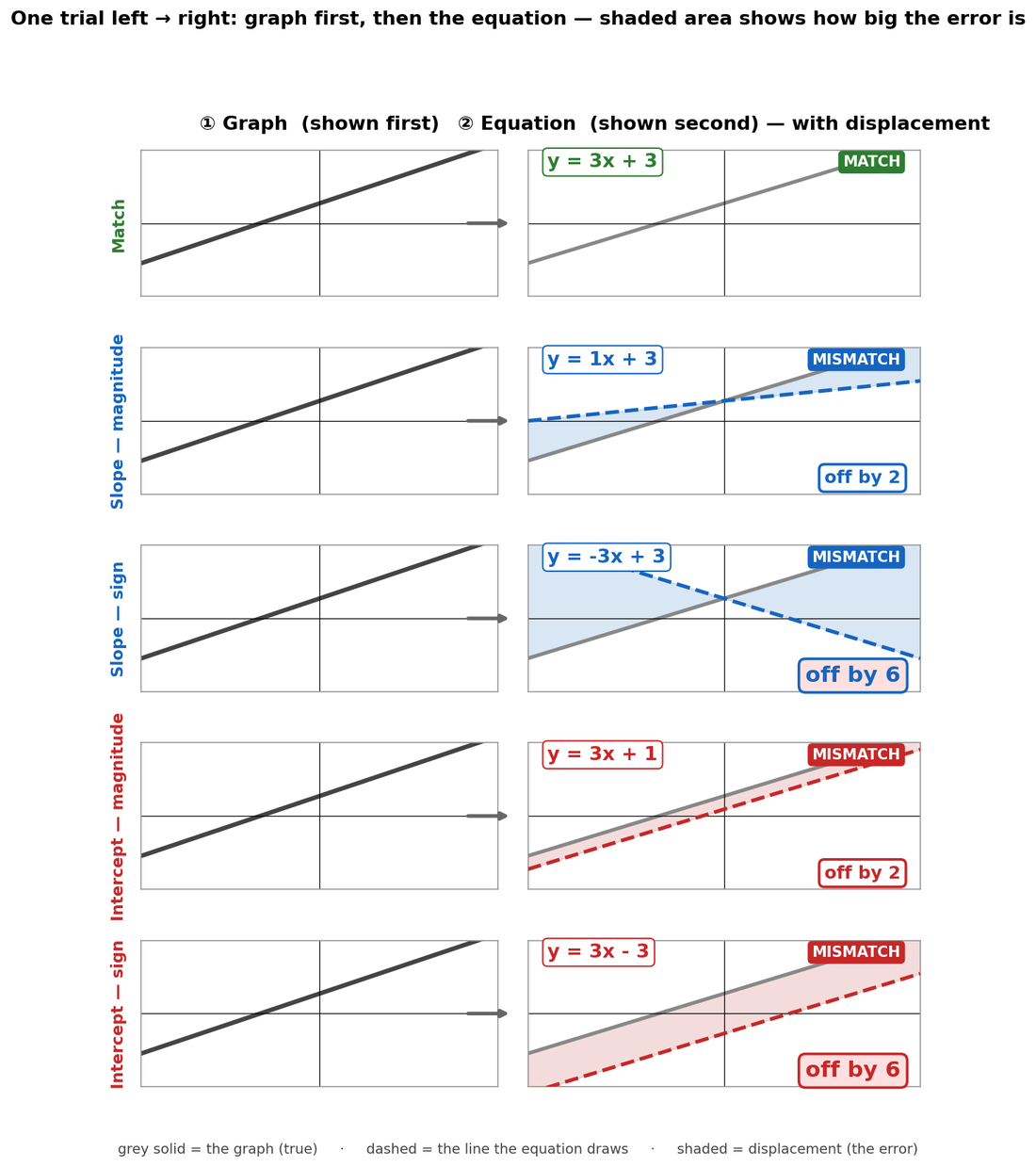
GRASP asks whether the brain processes algebraic relationships using the same semantic mechanisms it uses for language. On each trial, participants view a line graph of an equation (y = mx + b) followed by a written equation and judge whether the two match; on mismatch trials, either the slope or the intercept is altered so the equation no longer fits the graph. We test whether these equation-graph mismatches elicit an N400 (~400 ms post-stimulus) — an ERP signature classically tied to semantic incongruity in language — and whether the type (slope vs. intercept) and magnitude of the violation modulate the response. EEG is recorded with a 16-channel system, and machine-learning classification is applied to the ERP data to predict violation detection from neural patterns.
FAVE Experiment (Format-Dependent Arithmetic Verification with EEG)
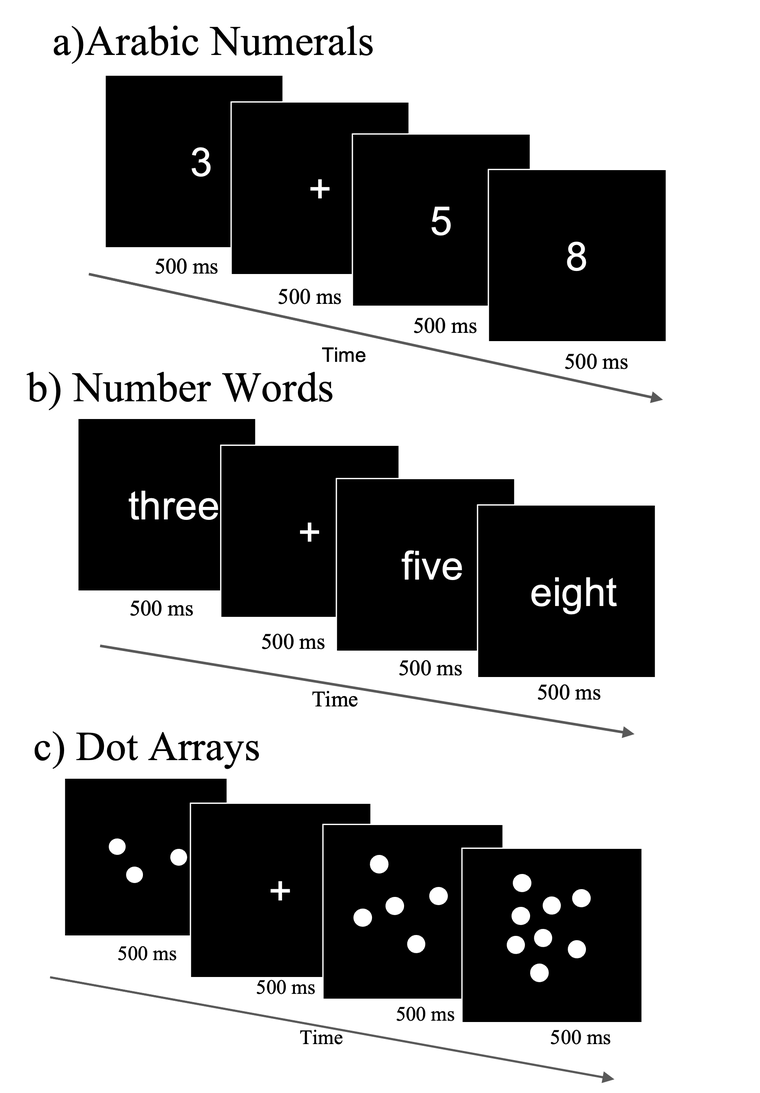
This EEG study tests whether numerical magnitude is represented by a single abstract code or by separate, format-specific systems. Participants verify addition and subtraction problems presented as Arabic numerals, number words, and dot arrays while we measure whether the N400 response to incorrect answers scales with violation distance across formats. This work was presented at the Minnesota Undergraduate Psychology Conference (MUPC 2026).